- CompetitionsDate de l'événement
From 28 June to 2 JulySite Internet
AddressBarcelone
SpainDeadlinePublished on 18/08/2025
Becoming. Architectures for a planet in transition
International Student Competition
© World Congress of Architects. Barcelona. UIA 2026 World Congress of Architects 2026
The UIA World Congress of Architects 2026 Barcelona is a unique international event for architectural dialogue, bringing together renowned architects, researchers, and leading figures from various disciplines. It is organised by the International Union of Architects (UIA, by its French acronym), a non-governmental organisation that unites national associations of architects from over 100 countries and represents more than one million professionals. The Congress takes place every three years in a different city. In 2026, it will be held in Barcelona, and the city has consequently been designated by UNESCO as the World Capital of Architecture 2026.
2026 Theme
Becoming explores spatial practices that foster the appropriation and transformation of our inhabited environments —both human and more-than-human, individual and collective— by investigating the potential of time as a design tool.
Six thematic research lines frame these explorations, inviting open-ended, intersecting investigations into what it means to design for a world in transition:
- Becoming More-than-Human calls to reimagine environments as complex, hybrid ecosystems for a multiplicity of species, with the emphasis on symbiosis and cooperation. This requires for an understanding of caregiving that extends beyond humans, advocating adaptive resilience in order to foster enhanced processes of transformation.
- Becoming Attuned claims an approach guided by empathy and desire, to acknowledge usually dismissed values: sensitivities that embrace uncertainty, the ordinary, mundane accidentality, physical and digital phenomena, and unexpected pleasures and delights.
- Becoming Embodied aims to explore the agency of materials by incorporating political, economic, ecological, and poetic relationships inherent to contemporary spatial practice and its technologies of construction. The way in which we extract, process, transport, use and reuse flows and exchanges of matter may be embedded in our commitment for social equity, gender perspective, decolonization, decarbonization, and energy transition.
- Becoming Interdependent re-evaluates traditional notions of space and labor, recognizing the increasingly blurred boundaries between productive and reproductive spheres, moving away from regulatory constructs, and embracing diversity and complexity.
- Becoming Hyper-Conscious calls for a deeper, immanent awareness —beyond data accumulation and critical description— empowering us to projectively and carefully transform our worlds.
- Becoming Circular promotes material circularity, energy flow recirculation, and spatial reprogramming offering a pathway towards a more regenerative and low-carbon built environment. This approach suggests rethinking spatial practice to explore alternative aesthetic imaginaries and methods that integrate, among others, reclaimed components, upcycled waste streams, design for future disassembly, organic and metabolic constructive materials, passive atmospheric strategies, thermodynamic interactions redifining comfort levels, and spatial reprogramming as an alternative to indiscriminate demolition.
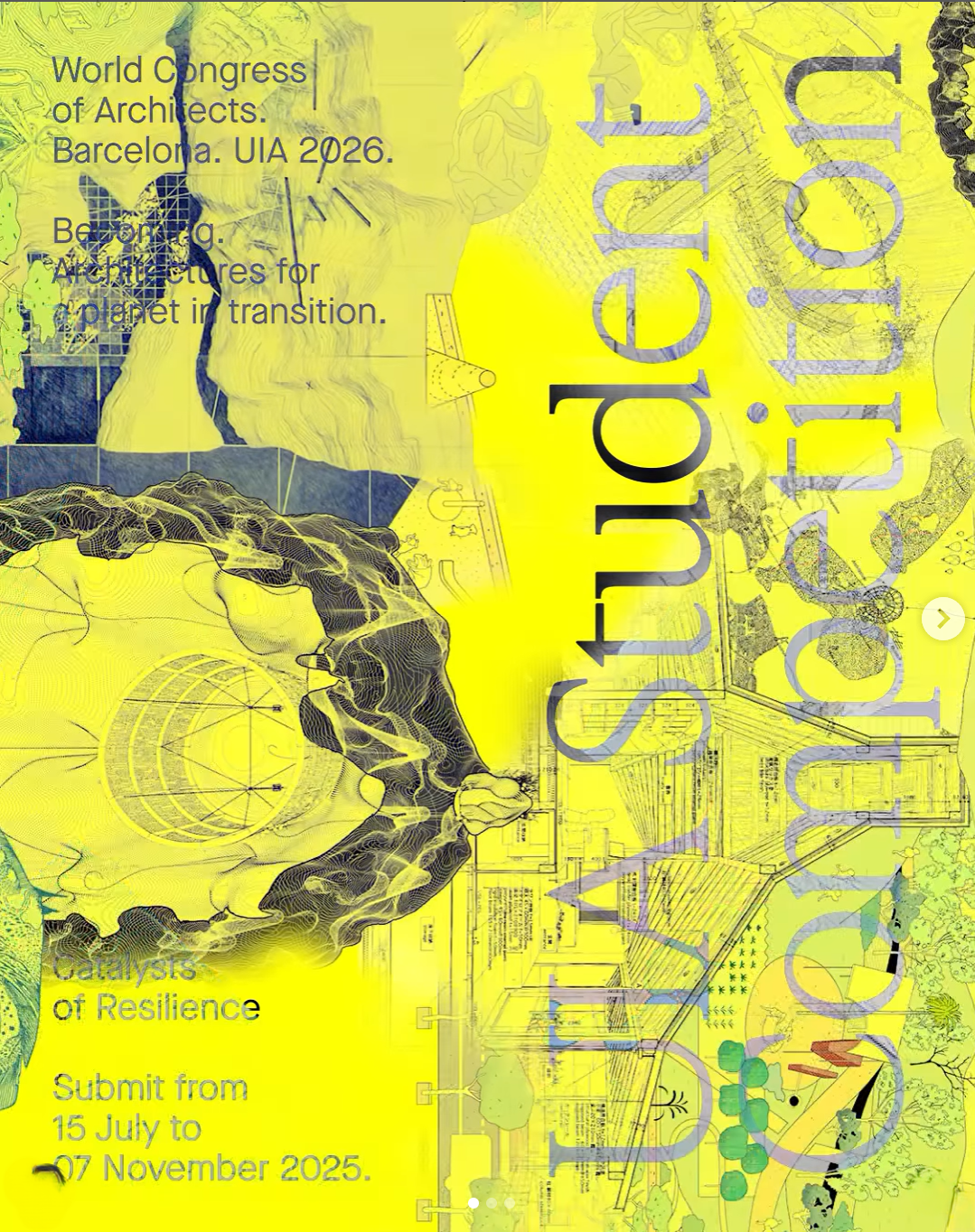
International Student Competition
The UIA International Student Competition is a prestigious global platform that challenges architecture students to tackle urgent architectural and urban issues through innovative design. Endorsed by the UIA, it fosters creativity, sustainability, and forward-thinking solutions. This single-stage ideas competition adheres to UNESCO’s Standard Regulations and UIA best practices, ensuring a fair and inspiring environment for aspiring architects. It provides a unique opportunity to showcase talent, engage with global challenges, and gain international recognition in the architectural field.
Under the title Catalysts of Resilience, it invites students to design spatial interventions that enable resistance and adaptation to predictable threats related to political shifts, social transformations, and climate change. The competition calls for design proposals that foster this capacity for resilience using time as a design tool.
Find all the information you need about preparing your application and the participation requirements on the official website.
The deadline is November 7, 2025.

Wallonie-Bruxelles Architectures is a cultural and economic promotion agency for architects from Brussels and Wallonia on the international stage.