- News
Published on 22/10/2026
Projects by Ouest and Rotor featured in the travelling exhibition Doble Exposición in Chile

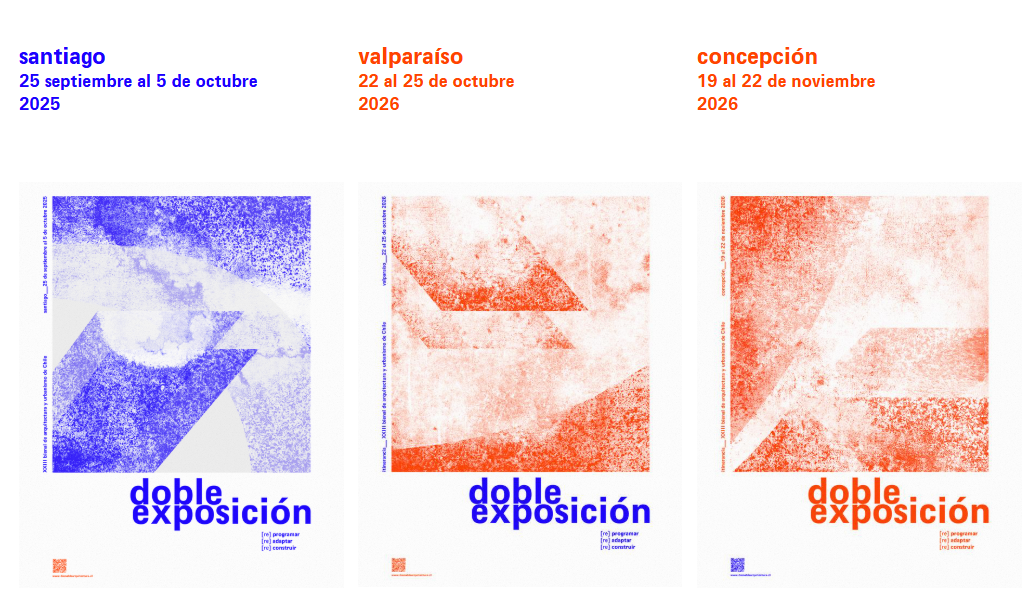
© Doble exposición Following its first presentation in Santiago in 2025, the exhibition Doble Exposición, organised as part of the 23rd Chilean Architecture and Urbanism Biennial, continues its tour in 2026 with stops in Valparaíso and Concepción.
Dedicated to the transformation of existing buildings, the exhibition brings together projects and reflections on reuse, renovation and new ways of intervening in the built environment. Among the selected contributions are those of the Brussels-based offices OUEST architecture and Rotor.
Transforming existing buildings: a collective reflection
Borrowed from photography, the concept of double exposure refers to the superimposition of several images to create a new perspective. Applied to architecture, it invites us to consider traces of the past as resources for imagining new uses.
Among the projects presented, Zinneke, developed by OUEST architecture, Rotor and the non-profit organisation Zinneke, illustrates this approach to transformation. Located on Place Masui in Brussels, the project involves the conversion of a former printing complex into a space for sociocultural production and exchange.
The intervention preserves and enhances the spatial and material qualities of the existing buildings while introducing new uses. Developed in collaboration with Rotor, which specialises in material reuse, the project makes extensive use of reclaimed components, questioning conventional construction methods and exploring the potential for more resource-efficient architecture.
The Brussels-based collective Rotor is also represented through Transmutation (2024), a film by Ila Bêka and Louise Lemoine, produced for the exhibition Entangled Matter, presented in Brussels in 2024 and curated by A+ Architecture in Belgium and Bozar.
The 48-minute film explores several industrial sites within a 200-kilometre radius of Brussels, where materials are produced, processed, reused or disposed of. Through these locations, it examines material flows, industrial activities and the contradictions of the circular economy, which remains closely tied to linear production models.
Practical information
- Valparaíso: 22–25 October 2026
- Concepción: 19–22 November 2026

Wallonie-Bruxelles Architectures is a cultural and economic promotion agency for architects from Brussels and Wallonia on the international stage.